

Home office boundaries are defined as the physical, temporal, and communicative limits that separate work from personal life within a shared living space. Without them, remote workers face a measurable cost: a 2026 study of over 3,200 workers across six countries found that burnout mediates the relationship between remote work intensity and mental health decline, moderated directly by boundary control. That finding reframes why boundaries in home office settings are not a comfort preference. They are a performance and health requirement. The field calls this “boundary management,” a recognized framework in occupational psychology covering how workers regulate the separation between work and non-work domains.
How do boundaries reduce burnout and support mental well-being?
Boundary control is the single strongest buffer between remote work and burnout. Workers who maintain high boundary control report exhaustion scores 35 points lower than peers carrying the same workload. That gap is not explained by hours worked. It is explained entirely by the presence or absence of clear limits around when and where work happens.
The mental health risks of poor boundary management compound over time. A 2026 study found that remote work five or more days per week correlates with higher anxiety risk, even when workers report liking their jobs. The implication is direct: full-time remote work without deliberate boundary structures creates chronic low-grade stress that accumulates into clinical anxiety.
Remote work without boundaries does not just feel harder. It measurably increases exhaustion, anxiety, and burnout risk, regardless of workload or job satisfaction. Boundary control is the variable that changes outcomes.
Occupational psychologists describe this through the lens of “psychological detachment,” the ability to mentally disengage from work during off hours. Without physical or temporal cues that signal the end of the workday, the brain stays in a low-level alert state. That state prevents recovery. Over weeks and months, incomplete recovery is the direct path to burnout.
What types of boundaries can remote workers establish?
Boundary management strategies fall into four practical categories: physical, temporal, communicative, and sensory. Each addresses a different way that work bleeds into personal life.
Physical boundaries involve dedicated workspace. A separate room is the clearest version, but even a specific desk in a shared room creates a spatial anchor for work mode. A 2026 U.S. study confirmed that physical boundary tactics yield the highest boundary control, job satisfaction, and psychological well-being of any single strategy tested.
Temporal boundaries mean defined start and end times. Structured schedules with intentional breaks reduce remote work burnout more effectively than unlimited flexibility. The counterintuitive finding here is that giving yourself total schedule freedom actually increases stress by removing the structure the brain uses to predict and prepare for rest.
Communicative boundaries cover how you signal availability to colleagues and household members. Sharing your calendar, setting status indicators, and stating response time expectations all fall here.
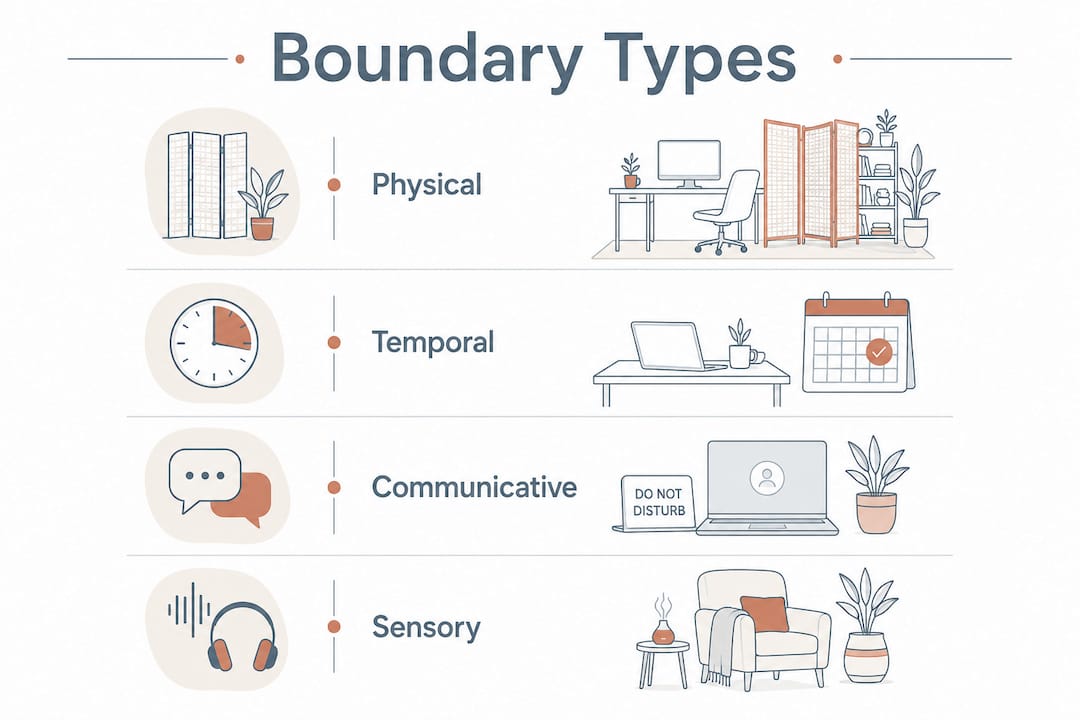
Sensory boundaries use sound, light, and smell to cue the brain into or out of work mode. A specific playlist, a desk lamp used only during work hours, or a particular scent can all function as environmental triggers.
| Boundary type | Example tactic | Primary benefit |
|---|---|---|
| Physical | Dedicated desk in a fixed location | Spatial separation of work and rest |
| Temporal | Fixed start and end times with a shutdown ritual | Predictable recovery windows |
| Communicative | Shared calendar and status updates | Reduced interruption and expectation clarity |
| Sensory | Work-only lighting or sound cues | Faster mental mode switching |
Pro Tip: Remote workers who combine all four boundary types recover better from work stress than those relying on any single approach. A 2026 study labeled this group “Uniform Strong Boundary Managers” and found they showed the best recovery experiences of any segment studied.
Why physical and environmental cues matter most
The brain does not switch between work and rest modes based on willpower. It responds to context. Boundary-setting works because it creates sensory and structural cues for the nervous system, not because a worker decides to stop thinking about email.

This is why physical rituals carry outsized weight. Closing the laptop, putting it in a drawer, and changing clothes are not symbolic gestures. They are shutdown rituals that signal a genuine state change to the brain. Without them, the laptop sitting open on the kitchen table keeps the nervous system primed for work even during dinner.
Even in small apartments, visual barriers like bookshelves and curtains create effective spatial distinctions between work and living areas. The brain reads these cues automatically. A corner of a room defined by a dedicated desk and a bookshelf behind it functions differently in the brain than the same corner with a couch cushion on the floor.
Pro Tip: If you work in a shared room, read about designing for dual-purpose spaces to create strong visual separation without a dedicated room.
The desk itself matters more than most remote workers realize. A fixed, purpose-built workspace signals to the brain that this location means work. A standing desk with adjustable height adds a physical ritual layer: raising or lowering the desk at the start and end of the workday becomes a reliable environmental cue. The Alto Home’s Gramercy and Tribeca desks are built specifically for this kind of dedicated home workspace, combining visual distinction with ergonomic function.
Lighting reinforces the effect. Natural light during work hours and dimmer, warmer light in the evening align the workspace environment with the body’s circadian rhythm, making the transition out of work mode faster and more complete.
How can remote workers manage communication expectations?
Communicating boundaries without apology is the most underused boundary tactic. Expert advice from Keith Lacy confirms that stating availability clearly normalizes expectations and accelerates acceptance from colleagues and managers. The key shift is framing boundaries as a performance strategy, not a personal preference.
Practically, this means:
- Stating your working hours in your email signature and calendar
- Setting an auto-reply for messages received outside those hours
- Responding to after-hours messages the next morning without explanation or apology
- Telling household members your schedule at the start of each week
- Using status indicators in workplace apps to show availability in real time
The digital side of communication boundaries carries measurable weight. Digital boundaries decrease stress levels by 40% and improve sleep quality by 44%, according to research cited by Atlassian. Those numbers reflect what happens when the brain stops anticipating work messages during off hours.
Pro Tip: Write your boundary statement once and reuse it. “I work 9:00 AM to 5:30 PM and respond to messages within those hours” is a complete, professional boundary. Saying it consistently builds the expectation faster than saying it perfectly.
The social discomfort of setting boundaries is real but short-lived. The initial awkwardness of telling a colleague you will not respond after 6:00 PM fades within a week. The cost of not setting that boundary accumulates for months. Reframing the discomfort as a one-time investment rather than an ongoing social risk makes it easier to act on.
Remote workers in “always on” workplace cultures face additional pressure. The solution is not to match the culture but to document boundaries clearly and perform them consistently. Consistency builds credibility. A worker who reliably responds within stated hours is trusted more, not less, than one who responds unpredictably at all hours.
Key Takeaways
Boundary control is the most effective tool remote workers have for preventing burnout, protecting mental health, and maintaining long-term productivity in a home office.
| Point | Details |
|---|---|
| Boundary control cuts exhaustion | Workers with high boundary control score 35 points lower on exhaustion scales despite equal workloads. |
| Physical tactics outperform all others | Dedicated desks and spatial separation deliver the highest boundary control and well-being scores. |
| Multi-strategy approach works best | Combining physical, temporal, communicative, and sensory boundaries produces the strongest recovery. |
| Digital limits protect sleep and reduce stress | Setting response time expectations cuts stress by 40% and improves sleep quality by 44%. |
| Communicate without apology | Stating boundaries clearly and consistently builds professional credibility and reduces personal anxiety. |
The boundary habit nobody talks about building
I have watched remote workers spend months trying to fix productivity problems that were actually boundary problems. They buy new apps, restructure their task lists, and experiment with time-blocking methods. None of it works because the real issue is that their brain never fully leaves work.
The research confirms what I have seen in practice. Single-strategy boundary efforts, like just setting a calendar or just having a dedicated desk, produce modest results. The workers who genuinely recover and sustain high output are the ones who stack physical, temporal, and communicative boundaries together. It is not complicated. It is just more deliberate than most people expect.
The piece of advice I give most often is this: design your shutdown ritual before you need it. Pick three specific actions that end your workday, do them in the same order every day for two weeks, and watch how quickly your brain starts to associate them with genuine rest. Closing the laptop, putting on a different pair of shoes, and making a cup of tea in that exact sequence becomes a neurological off switch. It sounds small. The effect is not.
The other thing I have learned is that boundary discomfort is front-loaded. The first time you tell a colleague you will not respond until morning, it feels risky. By the third time, it feels normal. The long-term cost of skipping that conversation is burnout. The short-term cost of having it is one awkward moment. That math is not close.
— Kevin O’Gara
A workspace that holds the boundary for you
Physical boundaries work best when the furniture itself signals the separation. A desk that looks and feels different from the rest of your home does part of the boundary work automatically.
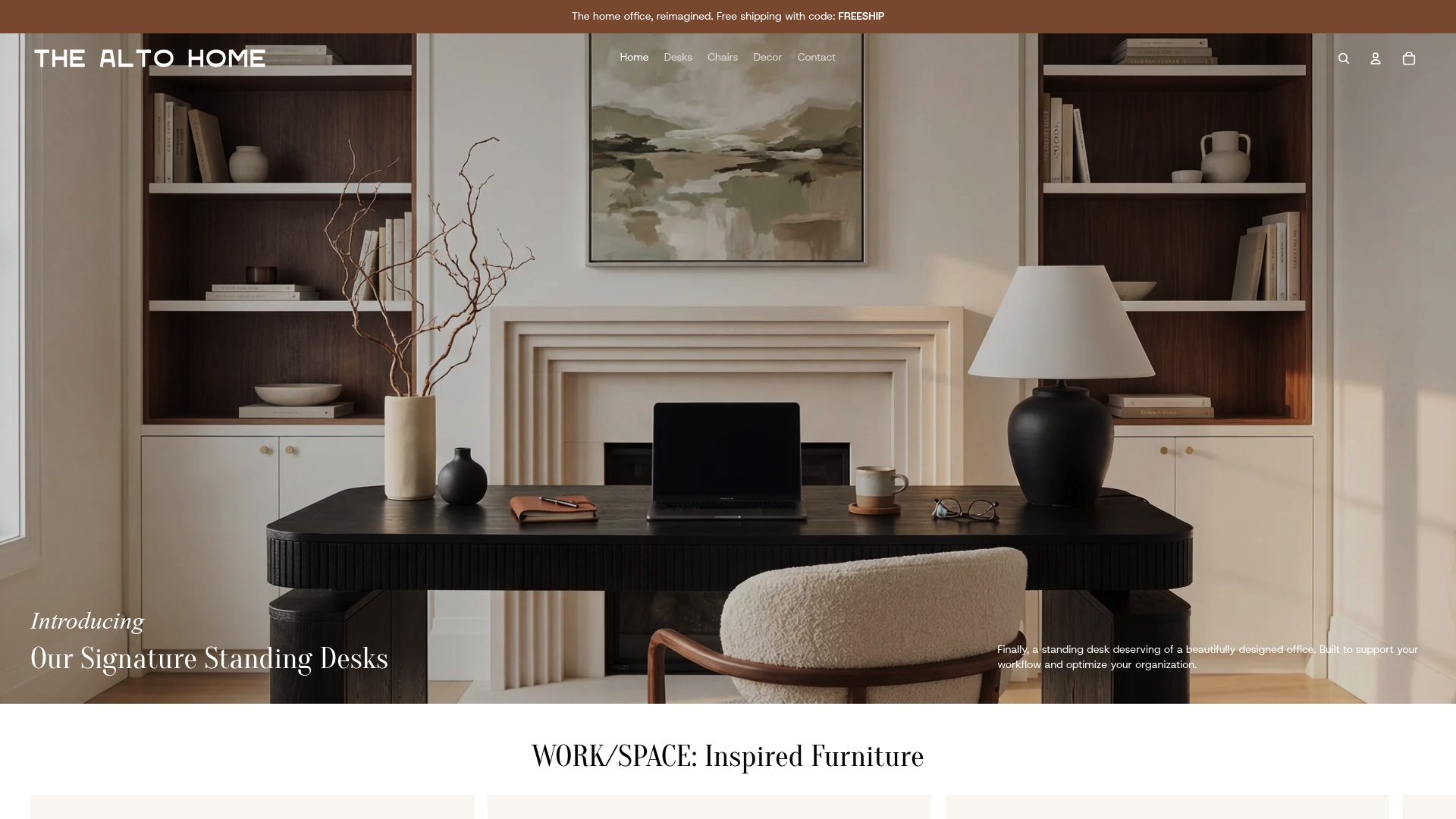
The Alto Home builds standing desks designed for exactly this purpose. The Gramercy Fluted Wood Standing Desk and the Greenwich Rotating Wood Standing Desk create a distinct visual anchor in any room, signaling to your brain and everyone around you that this space means work. Adjustable height adds a physical ritual: raise it to start, lower it to finish. The Alto Home’s full collection of adjustable standing desks pairs ergonomic function with the kind of design that makes a home office feel like a real workspace, not just a corner of the living room.
FAQ
Why do boundaries in a home office improve productivity?
Boundaries reduce the cognitive load of deciding when to work and when to stop. Workers with clear limits spend less mental energy managing transitions and more on actual output.
What is the most effective type of home office boundary?
Physical boundaries, such as a dedicated desk in a fixed location, deliver the highest boundary control and well-being scores of any single strategy, according to a 2026 U.S. study.
How do I set boundaries without damaging work relationships?
State your working hours clearly and consistently in your calendar, email signature, and status tools. Framing availability as a performance standard rather than a personal limit reduces friction with colleagues.
Can boundaries help with anxiety from remote work?
Yes. Research shows that full-time remote work without boundaries correlates with higher anxiety risk. Boundary control directly moderates that relationship by giving the nervous system predictable recovery windows.
Do I need a separate room to create effective home office boundaries?
No. Visual barriers like bookshelves, curtains, and a dedicated desk in a shared room create effective spatial separation. The brain responds to consistent environmental cues, not square footage.
