

The desk is the dominant focal point in any home office because it commands more visual weight than any other piece of furniture in the room. Interior designers call this concept “visual hierarchy,” and the desk sits at the top of it. Where you place your desk, how it faces, and what surrounds it determines the entire atmosphere of the space. Get it right, and the room feels intentional, calm, and productive. Get it wrong, and even an expensive setup feels chaotic.
What is the role of desk in room focal point design?
A desk acts as the room’s strongest focal point in a home office because of its size and visual dominance. No other piece of furniture occupies as much surface area or draws the eye as consistently. That dominance is not a problem to solve. It is a design asset to use.
The desk sets the tone for everything else in the room. Your chair, shelving, lighting, and accessories all read as secondary elements once the desk is placed. This is why designers plan around the desk first and fill in the rest later. Treating the desk as an afterthought produces rooms that feel assembled rather than designed.
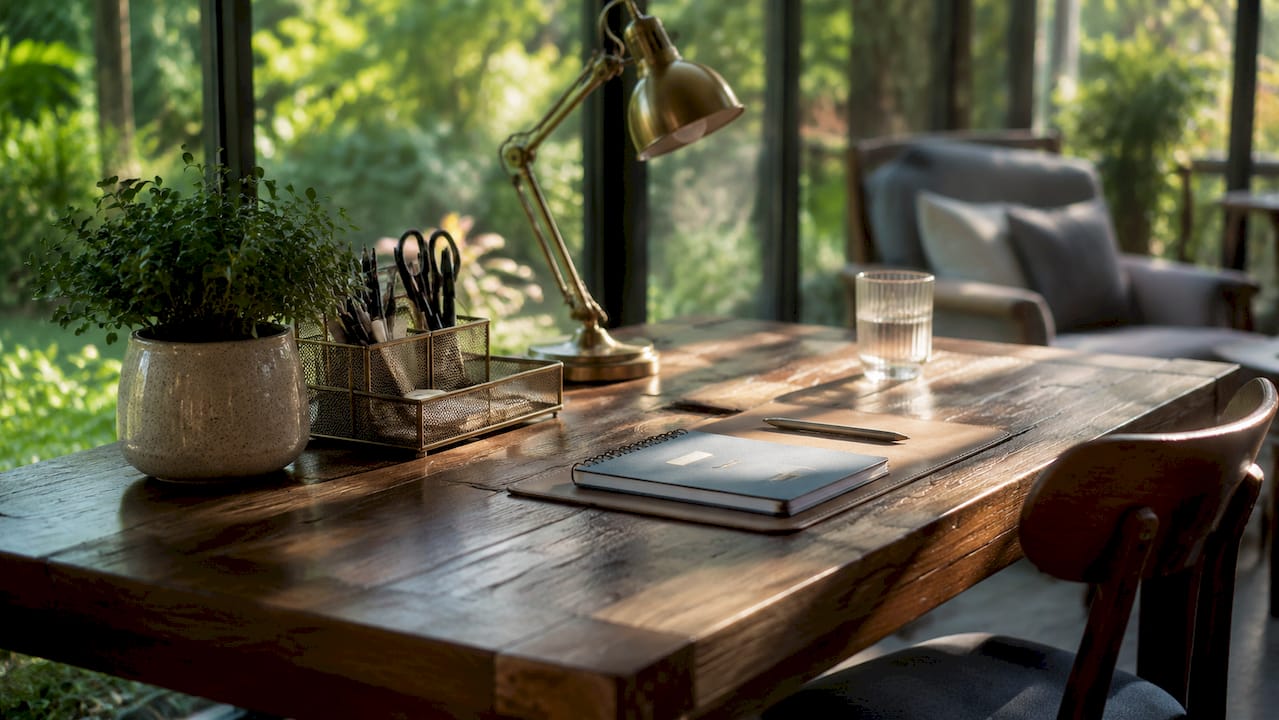
The role of desk in room composition goes beyond aesthetics. The desk anchors the spatial experience of the room, affecting your confidence and workflow from the moment you walk in. A well-placed desk signals that the space belongs to focused, purposeful work. That signal matters more than most people expect.
How does desk placement impact room layout and focal point effectiveness?
Desk placement is the single most consequential decision in a home office redesign. The position of your desk relative to walls, doors, and windows controls sightlines, traffic flow, and the psychological feel of the entire room.
The command position
Positioning the desk in the command position means placing it so you can see the room’s entrance without sitting directly in line with the door. Executives and high-end designers use this layout to create a sense of authority and control. Design psychology links this position with lower anxiety and better attention control. When your back faces the door, your nervous system registers a low-level threat, which fragments focus over a long workday.
The command position does not require a large room. Even in a compact home office, angling the desk diagonally toward a corner while keeping the entrance in your peripheral view achieves the same effect. The goal is sightline control, not square footage.
Clearance and traffic flow
The desk as room centerpiece only works when the surrounding space breathes. A minimum of 36 inches of clearance behind your chair allows you to push back and stand without hitting a wall or shelf. Tight clearance creates physical friction that compounds into mental friction over time.
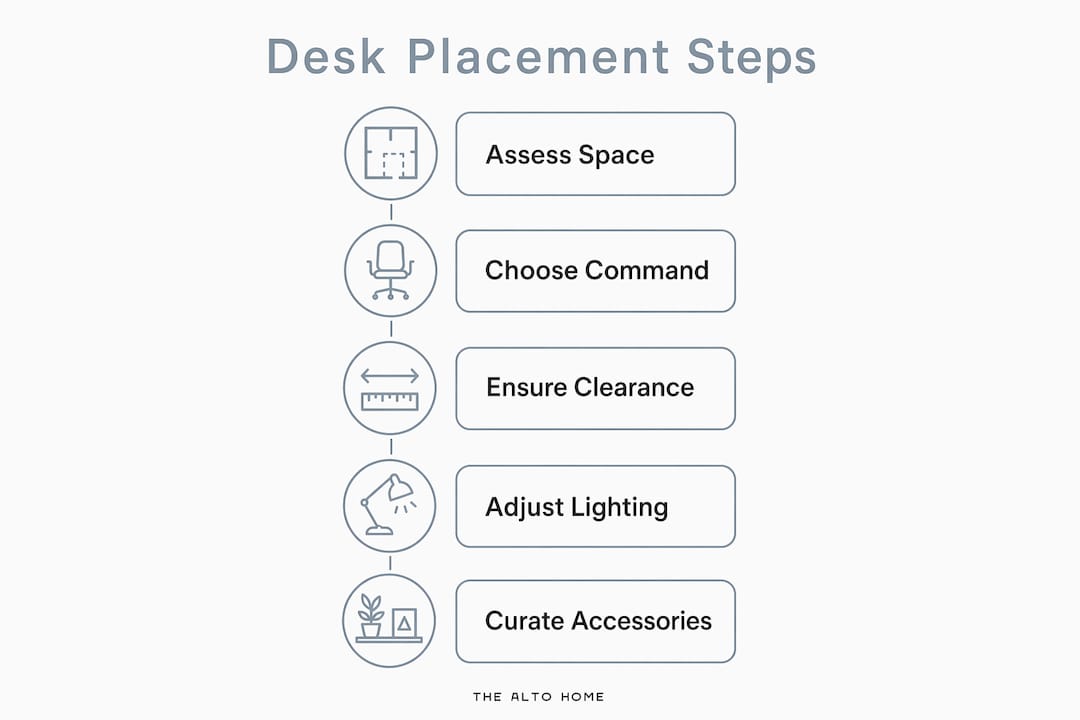
Avoid placing the desk flush against a blank wall as your first instinct. That setup kills the room’s dynamic flow and reduces the desk to a shelf with legs. If wall placement is unavoidable due to room size, the design solution is vertical layering, which the next section covers in detail.
Pro Tip: Adjusting your chair angle or rotating the desk slightly can simultaneously improve your sightline to the door and reduce monitor glare without repositioning the furniture drastically. Try a 10 to 15 degree rotation before committing to a full room rearrangement.
How should you orient your desk relative to windows?
Light direction is the most underestimated factor in desk placement. The wrong orientation causes glare, screen reflections, and eye fatigue that drain your energy without you realizing the source.
Placing the desk perpendicular to windows is the most stable natural lighting setup for long workdays. Side-lighting illuminates your workspace evenly without shining directly into your eyes or bouncing off your screen. It is the setup professional photographers and architects use at their own drafting tables for the same reason.
The most common mistakes in desk orientation are:
- Facing the window directly. Bright outdoor light behind your screen creates extreme contrast that forces your eyes to constantly readjust.
- Sitting with the window directly behind you. This casts glare across your monitor and, on video calls, silhouettes your face against the bright background.
- Ignoring seasonal light shifts. A setup that works in december may produce harsh afternoon glare by june when the sun angle changes.
- Overlooking sheer curtains. A single layer of sheer linen diffuses direct sunlight without blocking daylight, solving most glare problems at minimal cost.
Glare and reflections cause eye fatigue and reduce productivity. A slight desk or monitor angle adjustment can significantly improve glare control without moving the entire setup. For video calls specifically, avoid windows directly behind or in front of your monitor to maintain balanced, professional lighting. The natural light guide from The Alto Home covers seasonal adjustments and monitor positioning in greater depth.
What desk design elements create a stylish and functional focal point?
Creating a focal point with your desk requires more than choosing an attractive piece. The desk must relate to the room’s materials, scale, and vertical space in a way that feels considered rather than coincidental.
Material and finish choices
Wood tones with steel accents read as grounded and timeless in most home office settings. Mid-century modern lines, characterized by tapered legs and clean horizontal surfaces, work in both minimal and layered interiors. The Alto Home’s Tribeca Mid-Century Wood Standing Desk demonstrates how a single piece with strong design language can anchor an entire room without additional decoration. The types of wood finishes available affect how the desk reads under different lighting conditions, which matters more in a home office than in a showroom.
Vertical balance and wall placement
Floating shelves above a wall-placed desk create vertical balance and keep the space visually engaging. This approach transforms an otherwise flat wall setup into a designed focal zone. The shelves do not need to be symmetrical. An asymmetric arrangement of two shelves at different heights reads as more intentional than a matched pair.
When space constraints force the desk against a wall, vertical design elements draw attention upward and integrate the desk into the room’s full height. A tall plant, a framed print at eye level, or a pendant light positioned above the desk all achieve this effect.
The desk arrangement for visual impact also depends on what sits on the surface. Curated accessories, meaning three to five objects with a clear purpose or personal meaning, read as intentional. A crowded surface undermines the desk’s role as a focal point by creating visual noise that competes with the desk itself. The role of desk accessories in focus and output is worth studying before you style the surface.
For dual-purpose rooms, such as a bedroom that doubles as a home office, desk design for room harmony requires even more restraint. Choose a desk with closed storage or a clean profile that reads as furniture first and workstation second when you are not working.
How does the desk as a focal point influence room composition?
The desk’s influence on room composition extends well beyond its own footprint. As a spatial anchor, it determines where every other piece of furniture belongs.
| Desk placement scenario | Effect on room composition |
|---|---|
| Command position, facing entrance | Furniture arranges naturally around the desk; room feels purposeful on entry |
| Desk against wall, no vertical elements | Room feels flat; desk loses focal status to other surfaces |
| Desk centered in room with clear sightlines | Strong focal point; works best in larger rooms with adequate clearance |
| Desk in corner, angled outward | Efficient use of space; maintains sightline to door; suits smaller rooms |
| Desk facing window directly | Screen glare dominates; focal point weakened by visual discomfort |
Avoiding busy visual distractions near the desk focal point reduces cognitive load for deeper work. This means keeping the wall directly in your sightline relatively calm. A single piece of art, a simple shelf, or a neutral wall color behind the desk supports focus better than a gallery wall or open shelving packed with objects.
The importance of desk placement also shows up in how guests and clients perceive the space. A desk positioned in the command position with clear sightlines communicates competence before a word is spoken. That first impression is set by furniture arrangement, not decoration.
Supporting furniture should follow the desk’s lead. Your chair, monitor arm, and task light form the inner circle. Bookshelves, filing cabinets, and accent chairs form the outer circle. When the outer circle competes visually with the desk, the room loses its focal hierarchy. Keeping secondary furniture lower in height or pushed to the room’s perimeter preserves the desk’s visual authority.
Key Takeaways
The desk is the primary spatial anchor in a home office, and its placement, orientation, and design determine the room’s visual hierarchy, atmosphere, and productivity.
| Point | Details |
|---|---|
| Desk as focal anchor | The desk sets the room’s visual hierarchy; plan all other furniture around it. |
| Command position | Face the entrance from your desk to reduce anxiety and improve focus. |
| Side-lighting rule | Place the desk perpendicular to windows to minimize glare and eye fatigue. |
| Vertical balance | Add floating shelves above a wall-placed desk to maintain visual engagement. |
| Surface restraint | Limit desk accessories to three to five curated objects to preserve focal clarity. |
Why I stopped treating desk placement as an afterthought
Most people I have worked with on home office redesigns make the same mistake. They choose the desk first based on a photo, then figure out where it fits. That sequence produces rooms that look fine in pictures and feel wrong in person.
The real work is sightlines. I have seen a $200 desk in the command position outperform a $2,000 piece shoved into a corner. The placement does more for your focus and confidence than the material or finish. Once I started treating desk positioning as the first and most critical decision, every other element fell into place faster.
The second thing I have learned is that light is not a finishing touch. It is a structural element. A client once spent three months adjusting her monitor brightness trying to fix eye strain. One 15-degree desk rotation solved it. Proper window orientation relative to the desk mitigates contrast swings and reflection throughout the day. That single adjustment changed how long she could work comfortably.
For dual-purpose rooms, I always tell people to treat the desk as an investment in well-being, not just productivity. A desk with strong design language does not disappear when you close your laptop. It continues to shape the room’s atmosphere around the clock.
— Kevin O’Gara
Desks designed to anchor your home office
The Alto Home builds standing desks that function as genuine room focal points, not just work surfaces. Each piece is designed to hold its own visually while supporting the ergonomic habits that make long workdays sustainable.
The Greenwich Rotating Wood Standing Desk and the Gramercy Fluted Wood Standing Desk are built from high-quality wood with distinct finishes that integrate naturally into styled interiors. Both feature adjustable heights, so the desk works with your body as well as your room. Pair either with The Alto Home’s modern office chairs and home office decor to complete a cohesive focal zone that looks as good as it performs.
FAQ
What makes a desk a focal point in a room?
A desk becomes a focal point through its size, placement, and visual weight relative to other furniture. Positioning it in the command position, facing the entrance, reinforces its dominance in the room’s layout.
Where should I place my desk for the best room flow?
Place the desk so you face the room’s entrance with your back to a solid wall. This command position controls sightlines, reduces distraction, and anchors the surrounding furniture arrangement naturally.
How does desk shape affect room flow?
Desk shape determines how traffic moves around it and how the eye travels through the space. Rectangular desks with clean lines suit most rooms; L-shaped desks anchor corners but require more clearance to avoid blocking flow.
Should my desk face the window or sit beside it?
Place the desk perpendicular to the window, not facing it or with the window directly behind you. Side-lighting is the most stable natural lighting setup and prevents glare, screen reflections, and video call silhouetting.
How do I make a small home office feel intentional with a desk focal point?
Choose a desk with strong design language, angle it toward the room’s entrance if possible, and add one vertical element above it such as a floating shelf or framed print. Limit surface accessories to three to five objects to keep the focal point clean and readable.
