

Wood finishes for desks are protective coatings that shield wood surfaces from wear, moisture, heat, and UV damage while defining the final look and feel of the piece. The types of wood finishes for desks range from film-forming coatings like polyurethane and lacquer to penetrating finishes like Danish oil and hardwax oil. Each category behaves differently on the wood, and choosing the wrong one for your desk’s use intensity can mean a surface that scratches, clouds, or peels within months. This guide breaks down every major finish type, compares their durability and maintenance demands, and tells you exactly which one fits your situation.
1. Oil-based polyurethane: the gold standard for durability
Oil-based polyurethane is the most durable finish for high-traffic desks, outperforming water-based poly and tung oil in abrasion resistance and heat stability. It achieves 2,500 Taber abrasion cycles and holds stable to 150°F. That makes it the right call for any desk that sees daily keyboard use, coffee cups, and elbows.
The finish forms a hard film over the wood surface rather than soaking in. It adds a warm amber tone that deepens over time, which suits walnut, oak, and cherry particularly well. The trade-off is a 24-hour dry time between coats, and you will need 4–6 coats for a desk surface that holds up to real use.
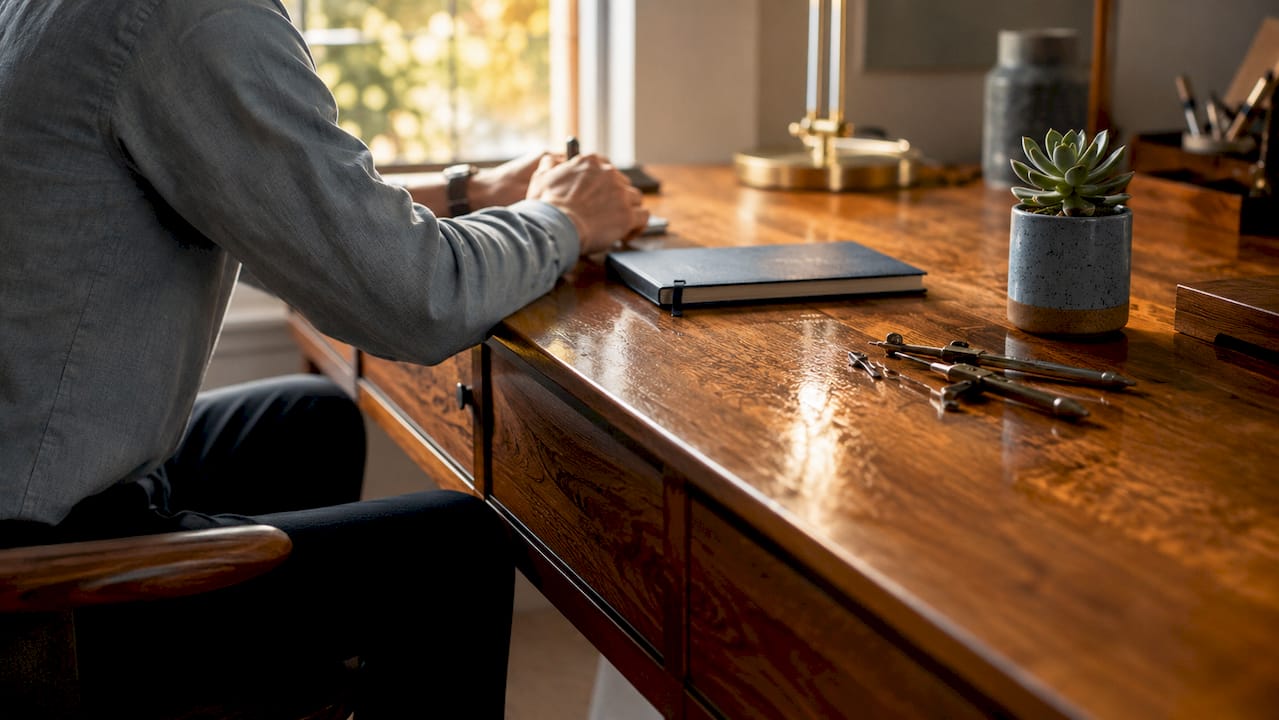
Pro Tip: Thin your first coat of oil-based poly with 10–15% mineral spirits and wipe it on. This reduces streaks and helps the finish bond evenly to the wood before you brush on thicker subsequent coats.
2. Water-based polyurethane: low odor, clear finish
Water-based polyurethane dries clear without ambering, has lower VOCs than oil-based formulas, and is the preferred choice for hobbyists and small home workshops. It dries faster, with a recoat window of 2–4 hours compared to 24 hours for oil-based versions. That speed advantage means you can apply multiple coats in a single day.
The downside is durability. Water-based poly reaches around 1,800 Taber abrasion cycles, which is measurably less than oil-based. For a light-use home office desk or a desk in a low-humidity climate, that gap rarely matters. For a standing desk you use eight hours a day, it does.
3. Lacquer: fast drying, high gloss, spray only
Lacquer recoats in just 10–30 minutes, making it the fastest finish in the category. That speed is a genuine advantage in production settings. The catch is that lacquer requires spray equipment to apply correctly. Brushing lacquer almost always leaves streaks and bubbles on a flat desk surface.
Lacquer delivers a hard, high-gloss film that looks sharp on mid-century modern and contemporary desk designs. Its durability sits below oil-based poly, and it is more vulnerable to water rings and heat marks than polyurethane. For a display desk or a writing desk with light use, lacquer is a strong choice. For a daily computer workstation, it is not the best fit.
4. Danish oil and oil blends: grain-forward, softer protection
Danish oil is a penetrating finish, meaning it cures inside the wood grain rather than forming a film on top. That distinction matters because penetrating finishes are easier to repair but offer far less surface hardness than film-forming coatings like polyurethane. A scratch in Danish oil blends back in with a fresh application. A scratch in poly requires sanding and recoating.
Danish oil enhances the natural grain and color of the wood beautifully. It leaves a matte, tactile surface that feels like wood rather than plastic. The trade-off is maintenance. Mineral oil and similar penetrating oils require frequent reapplication to stay effective, and they will not stand up to heavy daily use without showing wear.
5. Hardwax oils: natural feel with better durability
Hardwax oils like Rubio Monocoat and Osmo Polyx sit between penetrating oils and film finishes in terms of protection. They penetrate and cure within the wood to provide durable protection while maintaining the natural hand feel of the surface. You do not get the plasticky look that thick poly coatings sometimes produce.
Rubio Monocoat is a single-coat formula that bonds at the molecular level with wood fibers. Osmo Polyx is a two-coat system that builds slightly more surface protection. Both are well suited for decorative or moderate-use desks where the natural wood aesthetic is the priority. Neither matches oil-based poly for raw abrasion resistance on a high-contact work surface.
6. Wax finishes: topcoat only, not a standalone option
Wax finishes like paste wax or carnauba wax are not standalone desk coatings. They work as a maintenance layer applied over a cured oil or hardwax oil finish to add a light sheen and minor water repellency. Applying wax directly to bare wood provides almost no real protection against scratches, heat, or moisture.
Wax is useful for refreshing a hardwax oil finish between full reapplications. It buffs out easily and adds a soft luster without changing the color of the wood. For a desk that already has a solid oil finish, a wax topcoat every few months keeps the surface looking fresh with minimal effort.
How wood species and desk use affect your finish choice
Wood species is one of the most overlooked factors in finish selection. Porous, open-grain woods like oak and ash accept almost any finish evenly. Oily tropical woods like teak and rosewood are a different story.
Oily tropical woods commonly inhibit the drying agents in oil-based finishes, leaving them tacky for days. Hardwax oils are the better choice for teak and similar species. Pine and other high-porosity softwoods may blotch badly under oil-based finishes without a pre-conditioner applied first.
Desk use intensity drives the finish decision just as much as wood species:
- High-contact desks (daily computer use, standing desks): oil-based polyurethane or water-based poly
- Moderate-use desks (home office writing desks, occasional use): hardwax oils or water-based poly
- Decorative or display desks (low contact, aesthetic focus): Danish oil, hardwax oil, or shellac
- Oily wood species (teak, rosewood, ipe): hardwax oils like Osmo or Rubio Monocoat
- Porous wood species (oak, ash, walnut): oil-based poly, water-based poly, or hardwax oil
Pro Tip: If you are finishing a pine desk, apply a wood conditioner before any oil-based stain or finish. Pine absorbs finish unevenly, and conditioner prevents the blotchy, streaky result that is common on softwoods.
Finish comparison: durability, application, and maintenance
The table below compares the six main wood desk coatings on the factors that matter most for a desk purchase or refinishing project.
| Finish type | Abrasion resistance | Application method | Dry/recoat time | Maintenance |
|---|---|---|---|---|
| Oil-based polyurethane | Very high (2,500 cycles) | Brush or wipe-on | 24 hrs between coats | Low; sand and recoat every few years |
| Water-based polyurethane | High (1,800 cycles) | Brush or wipe-on | 2–4 hrs between coats | Low; recoat less often than oil |
| Lacquer | Moderate | Spray only | 10–30 min between coats | Moderate; vulnerable to heat and water |
| Danish oil / oil blends | Low | Wipe-on | 24 hrs; multiple applications | High; reapply every 6–12 months |
| Hardwax oil (Rubio, Osmo) | Medium | Wipe-on | 24 hrs; 1–2 coats | Medium; refresh with wax or reapply oil |
| Wax | Very low | Buff-on | 30–60 min | High; reapply every 1–3 months |
Finish choice also dictates maintenance frequency: penetrating oils need the most upkeep, while polyurethanes and hardwax oils are more low-maintenance over time. That ongoing time cost is worth factoring into your decision alongside the initial application effort.
Practical tips for applying and maintaining desk finishes
Getting the application right matters as much as choosing the right finish. A well-chosen finish applied poorly will fail faster than a lesser finish applied correctly.
- Sand before you start. Work through grits from 80 to 220 before applying any finish. Finish does not hide scratches. It magnifies them.
- Thin your first coat of poly. Mix oil-based polyurethane with 10–15% mineral spirits for the first coat and wipe it on with a lint-free cloth. This seals the wood evenly and prevents the thick first coat from pulling up grain.
- Sand lightly between coats. Use 320-grit sandpaper between poly coats to knock down dust nibs and improve adhesion. Wipe away all dust before the next coat.
- Choose satin over gloss. Satin and matte sheens hide fingerprints and dust far better than gloss finishes on desk surfaces. Gloss shows every smudge and requires more frequent cleaning to look presentable.
- Match your sheen across coats. Use the same sheen level for all coats, or use gloss for base coats and satin only for the final coat. Mixing sheens randomly produces an uneven appearance.
- Maintain penetrating finishes on schedule. Danish oil and hardwax oil surfaces need a fresh application every 6–12 months on active desks. Waiting until the surface looks dry or dull means the wood has already lost protection.
- Repair film finishes with spot sanding. A scratch in polyurethane can be spot-sanded with 400-grit paper and touched up with a fresh coat. You do not need to strip the entire desk for minor damage.
Key takeaways
The best finish for a desk is oil-based polyurethane for high-traffic use, hardwax oil for a natural feel on moderate-use surfaces, and penetrating oils only where aesthetics outweigh durability needs.
| Point | Details |
|---|---|
| Oil-based poly leads on durability | It reaches 2,500 Taber abrasion cycles and resists heat to 150°F, making it best for daily-use desks. |
| Wood species changes your options | Oily woods like teak need hardwax oils; porous woods like oak accept nearly any finish evenly. |
| Satin sheen beats gloss for desks | Satin and matte finishes hide fingerprints and dust far better than high-gloss coatings on work surfaces. |
| Application technique is half the job | Thinning the first poly coat and sanding between layers prevents streaks and ensures a durable, even film. |
| Penetrating oils need regular upkeep | Danish oil and similar finishes require reapplication every 6–12 months on active desk surfaces. |
Why I always come back to oil-based poly for working desks
After years of testing finishes on everything from reclaimed oak writing desks to solid walnut standing desks, my honest position is this: oil-based polyurethane is the right answer for most people finishing a desk they actually use. The amber warmth it adds to wood is a feature, not a flaw. It deepens the grain in a way that water-based finishes simply do not replicate.
The argument for hardwax oils is real, and I understand it. Rubio Monocoat looks stunning on white oak. The surface feels like wood, not like a laminated countertop. But on a desk where you are setting down coffee, dragging a laptop, and resting your wrists for hours every day, that natural feel comes with a maintenance commitment that most people underestimate. I have seen beautiful hardwax oil desks turn gray and dry in under a year because the owner did not know they needed to refresh the finish.
The one piece of advice I give everyone is to choose satin sheen. Gloss looks impressive in a showroom and terrible after two weeks of real use. Satin hides the evidence of daily life and still shows off the wood grain. That combination of practicality and good looks is what a working desk actually needs.
— Kevin O’Gara
The Alto Home desks: where finish quality meets daily function

The Alto Home builds its standing desks with real wood surfaces and finishes chosen to hold up under daily use while looking genuinely good in a home office. The Gramercy Fluted Wood Standing Desk and the Tribeca Mid-Century Wood Standing Desk both feature carefully finished wood tops that balance durability with the warm, natural aesthetic that makes a home office worth spending time in. The Greenwich Rotating Wood Standing Desk takes that further with a rotating surface and a finish built for active, all-day use. All three desks are electric height-adjustable, so the surface finish works alongside ergonomic function rather than against it. If you are building a home office setup where the desk needs to look as good as it performs, The Alto Home’s wood desk collection is worth a close look.
FAQ
What is the most durable finish for a wood desk?
Oil-based polyurethane is the most durable finish for wood desks, reaching 2,500 Taber abrasion cycles and holding stable to 150°F. It outperforms water-based poly, lacquer, and penetrating oils on high-contact surfaces.
What is the difference between a film finish and a penetrating finish?
Film finishes like polyurethane and lacquer form a protective layer on top of the wood, while penetrating finishes like Danish oil and hardwax oil cure inside the wood grain. Film finishes are more durable; penetrating finishes are easier to repair and feel more natural.
Can I use wax as the only finish on a desk?
Wax alone does not provide enough protection for a desk surface. It works as a maintenance topcoat over a cured oil or hardwax oil finish, but applying wax directly to bare wood leaves the surface vulnerable to scratches, moisture, and heat.
Which finish works best on oily woods like teak?
Hardwax oils like Osmo Polyx or Rubio Monocoat are the best choice for oily tropical woods. Oil-based finishes often stay tacky on teak and rosewood because the natural oils in the wood interfere with the finish’s drying agents.
Does sheen level affect how a desk finish performs?
Sheen level affects appearance and how well the finish hides daily marks, but not raw durability. Satin and matte finishes hide fingerprints and dust far better than gloss, making them the practical choice for any desk used daily.
Recommended
- The Gramercy Fluted Wood Standing Desk | Electric Adjustable Desk – The Alto Home
- The Greenwich Rotating Wood Standing Desk | Electric Adjustable Desk – The Alto Home
- The Bowery Mid-Century Wood Lift Top Desk | Desk With Power Outlet – The Alto Home
- The Tribeca Mid-Century Standing Desk | Electric Adjustable Desk – The Alto Home
