

Desk legs are the defining signatures of furniture design eras, encoding the craftsmanship, cultural values, and technological capabilities of every period from the Jacobean age through Mid-Century Modern. Understanding why desk legs define design era means reading them as historical documents, not just structural supports. Each curve, taper, and joint tells you when a piece was made, who made it, and what that society valued. The Jacobean era produced thick turned legs built for permanence. The Georgian period answered with the cabriole leg, a form so technically demanding it signaled wealth. Mid-Century Modern stripped everything back to hairpin metal and clean geometry. Leg style is the fastest, most reliable way to date a desk.
Why desk legs define design era: the historical evidence
Distinct desk leg styles uniquely identify furniture periods from Jacobean through Mid-Century Modern, making them the clearest single marker in furniture dating. That claim holds because each era’s dominant leg form emerged directly from the tools, materials, and social priorities of its time. No other element of a desk changes as visibly or as consistently across periods.
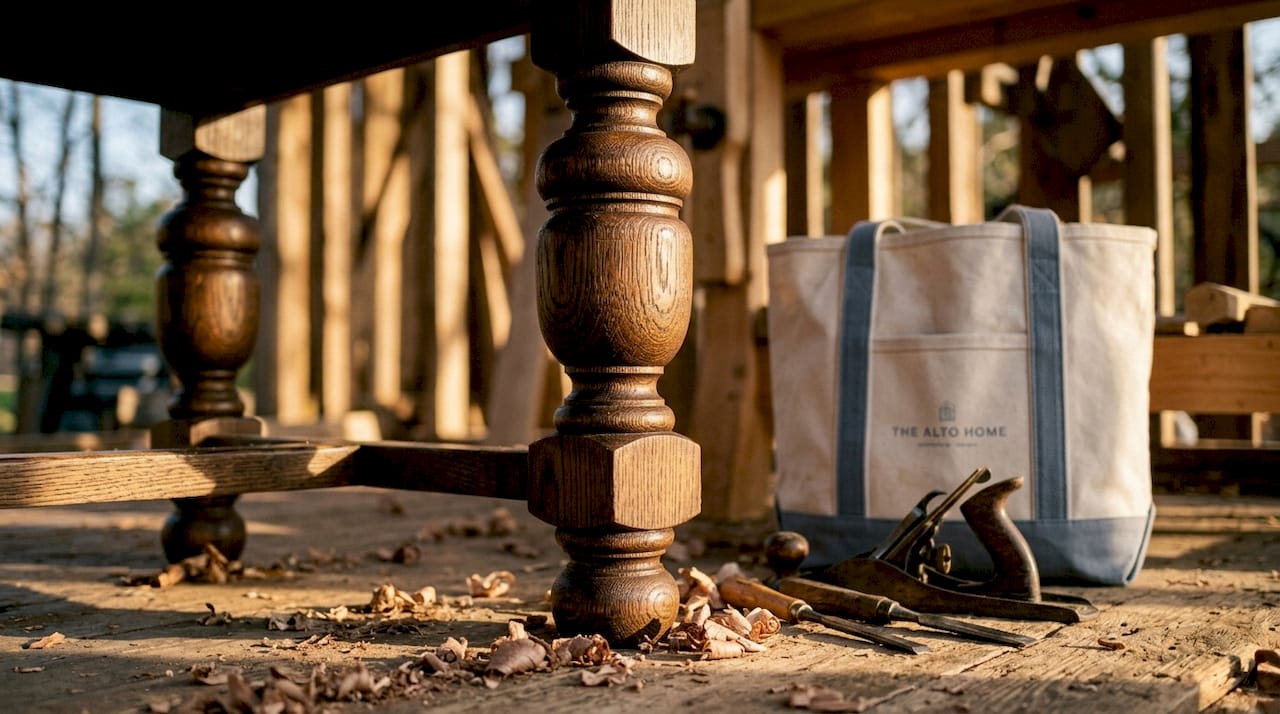
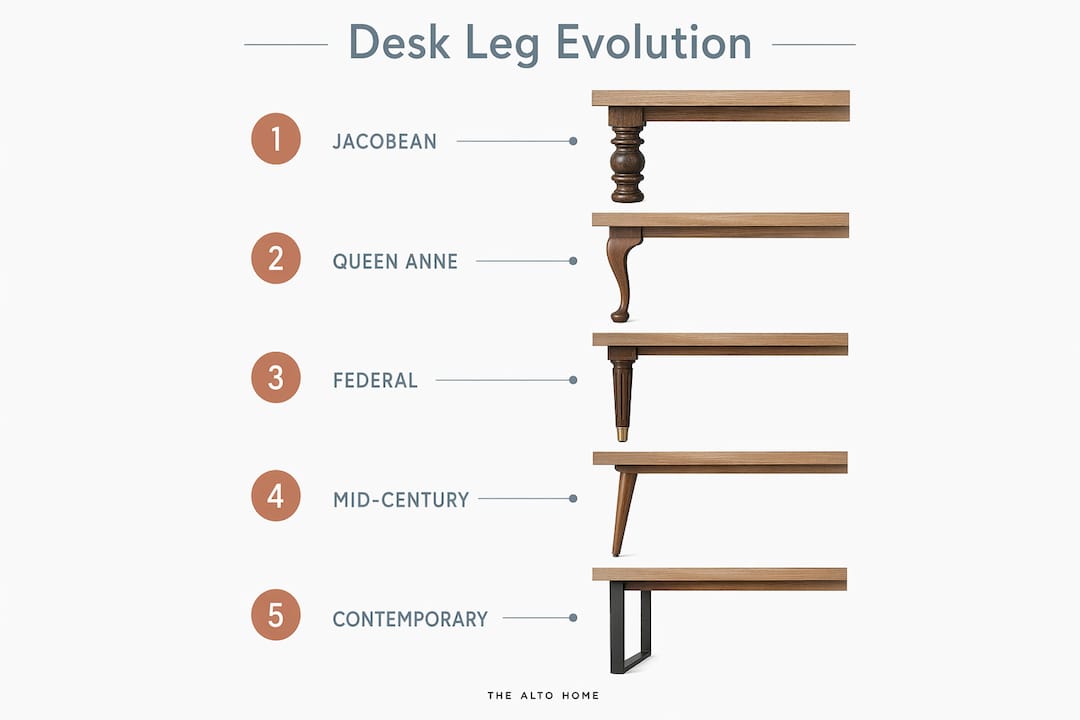
The Jacobean period (1600–1690) produced thick, heavily turned legs joined by low stretchers running close to the floor. Those stretchers existed because the legs needed lateral support. Woodworking technology of the period could not yet produce the refined joinery that would later allow freestanding tapered legs. The result was a desk that looked solid, even fortress-like, because it had to be.
Queen Anne and Chippendale designs (1700–1790) introduced the cabriole leg, a form with a convex outer curve and a concave inner curve terminating in either a pad foot or a ball-and-claw foot. Cabriole legs required precise craftsmanship to avoid structural failure, which is exactly why they were reserved for high-status furniture in Georgian and Rococo periods. A desk with a well-executed cabriole leg was a status statement as much as a functional object.
The Federal period (1780–1810) rejected that ornamental excess. Hepplewhite and Sheraton designs favored straight tapered legs, often inlaid with contrasting wood veneers. The taper ratio mattered: Georgian legs taper approximately 1:25 with a finished height of 28–32 inches, a proportion that reads as elegant without appearing fragile. Mid-Century Modern (1945–1970) then pushed further, introducing metal hairpin legs invented in 1941 and wood laminates that made slender, geometric forms structurally viable.
Era-by-era leg style comparison
| Era | Period | Leg Style | Key Characteristic |
|---|---|---|---|
| Jacobean | 1600–1690 | Thick turned legs with stretchers | Heavy, symmetrical turning; low floor stretchers |
| Queen Anne / Chippendale | 1700–1790 | Cabriole with pad or ball-and-claw foot | Double curve; status-driven ornament |
| Federal / Hepplewhite | 1780–1810 | Straight tapered leg | Inlay detail; refined proportion |
| Mid-Century Modern | 1945–1970 | Hairpin metal or splayed wood | Geometric minimalism; industrial materials |
How did desk leg design evolve over time?
The evolution of desk leg design tracks a clear arc from structural necessity toward expressive form, then back toward functional minimalism. Medieval lectern desks used heavy, blocky supports because the joinery technology of the period demanded mass for stability. As woodworking tools improved and trade routes brought new hardwoods like mahogany into European workshops, makers gained the ability to cut thinner, more refined forms without sacrificing strength.
Ancient Egyptian table legs carved to resemble lions or bulls projected strength and divine protection. That symbolic logic carried forward: the ball-and-claw foot of 18th-century Chippendale furniture represents a dragon clutching a pearl, a motif that communicated the patron’s stature. Leg design was never purely functional. It was always a language.
The key technological and cultural forces that shaped leg design across history are:
- Joinery advances. The shift from mortise-and-tenon joints reinforced by stretchers to refined dovetail joinery allowed makers to remove floor-level stretchers entirely, opening up desk silhouettes and improving legroom.
- Material availability. The arrival of Caribbean mahogany in 18th-century England gave makers a dense, stable hardwood that could hold a thin taper without splitting, directly enabling the Federal leg style.
- Industrial manufacturing. Machine cutting in the Victorian era made previously labor-intensive leg forms reproducible at scale, which both democratized design and diluted the craftsmanship signal.
- Ergonomic awareness. The transition from heavy medieval desk forms to open modern structures removed central stretchers specifically to improve seated comfort, showing that ergonomics shaped aesthetics long before the word existed.
- Cultural minimalism. Post-World War II design movements rejected ornament as a moral position. The hairpin leg was not just cheaper to produce. It was a deliberate aesthetic statement about honesty in materials.
Pro Tip: When studying leg evolution, trace the stretcher. When stretchers disappear from a design, it signals a joinery breakthrough. That single detail narrows a piece’s date range faster than almost any other clue.
How does craftsmanship reveal a desk’s true period?
Craftsmanship is the authentication layer beneath leg style. Two desks can share the same cabriole leg profile yet belong to completely different centuries. The joinery is what separates them. Hand-cut dovetails with irregular spacing and slight asymmetry indicate an original period piece. Machine-cut joints with perfectly uniform spacing suggest a Victorian reproduction or later revival.
The cabriole leg itself is one of the most technically demanding forms in furniture history. Hand carving a cabriole leg requires reading wood grain direction to prevent splits along the concave inner curve, where stress concentrates. A maker who got that decision wrong produced a leg that failed within years. A maker who got it right produced a leg still standing three centuries later. That skill gap is visible to a trained eye.
Key craftsmanship indicators that help date a desk accurately:
- Dovetail regularity. Hand-cut dovetails are slightly irregular. Machine-cut dovetails are perfectly uniform. Uniformity points to post-1860 production.
- Surface tool marks. Hand planes leave faint, slightly curved marks on flat surfaces. Machine-planed surfaces are uniformly smooth. Check the underside of the desk top and the inside faces of the legs.
- Wear patterns. Genuine period pieces show wear concentrated at contact points: feet, drawer edges, and stretcher tops. Reproduction wear is often distributed too evenly or applied artificially.
- Wood shrinkage. Old wood shrinks across the grain over decades. A genuinely old circular element will measure slightly oval. A new reproduction will measure perfectly round.
Pro Tip: Bring a small flashlight to any antique assessment. Raking light across a leg surface reveals tool marks, repairs, and finish layers that flat overhead lighting completely hides.
Leg style is critical to identifying a piece’s period but must be confirmed with joinery and wear evidence, because stylistic revivals have reproduced nearly every historic leg form at least once.
How can design students apply leg style knowledge practically?
Leg style knowledge becomes useful the moment you move from reading about it to looking for it. The fastest skill a design student can build is the habit of photographing furniture details before stepping back for a full shot. Close-up photos of the leg, foot, and joinery provide the most reliable evidence for period classification, more so than any wide-angle overview.
Practical applications for design students and enthusiasts:
- Museum visits. Stand-level photographs of desk legs in museum collections give you a reference library of authentic period forms. Most museums allow photography without flash.
- Auction catalogs. Major auction houses publish detailed condition reports with close-up photography. These are free, expert-curated visual resources.
- Restoration projects. When restoring a period desk, match the leg taper ratio and foot profile exactly. A Federal desk with a slightly wrong taper reads as wrong to any trained observer, even if they cannot immediately say why.
- Contemporary design. Understanding historical leg proportions gives you a vocabulary for evaluating modern desks. A desk with splayed legs at 10 degrees reads as Mid-Century. A desk with straight tapered legs reads as Federal. Knowing the reference makes the design choice deliberate rather than accidental.
The Alto Home’s Mid-Century Modern desk design guide shows how these historical proportions translate directly into contemporary standing desk design, with hairpin-influenced leg geometries that carry the same visual logic as the 1941 originals.
| Application | What to Look For | Why It Matters |
|---|---|---|
| Period identification | Taper ratio, foot profile, joinery type | Narrows date range to within decades |
| Restoration work | Original leg dimensions and wood species | Maintains visual and structural authenticity |
| Contemporary design | Proportion and silhouette reference | Grounds modern choices in proven aesthetics |
| Collection building | Wear patterns and tool marks | Distinguishes originals from reproductions |
Key Takeaways
Desk leg styles are the most reliable single indicator of furniture design era, encoding each period’s technology, cultural values, and craftsmanship standards in one visible structural element.
| Point | Details |
|---|---|
| Legs date a desk | Each era produced a distinct leg form tied directly to its tools, materials, and social values. |
| Joinery confirms the period | Hand-cut irregular dovetails indicate original period pieces; machine-cut joints suggest Victorian or later reproductions. |
| Symbolism was intentional | Animal-form Egyptian legs and ball-and-claw Chippendale feet were deliberate status signals, not decoration. |
| Close-up photography works best | Photographing leg, foot, and joinery details gives more reliable identification evidence than full-piece shots. |
| Historical proportions inform modern design | Taper ratios and silhouettes from Federal and Mid-Century eras remain active references in contemporary desk design. |
Legs as historical storytellers: a designer’s perspective
The detail that most designers miss is how conservative leg design actually is. Every major leg style in history arrived as a reaction to the previous one. The Federal taper rejected Chippendale ornament. The hairpin leg rejected Victorian excess. Design students often treat these shifts as aesthetic preferences, but they are arguments. Each leg style is a position statement about what furniture should be and who it should serve.
What I find genuinely underappreciated is the role of failure in leg design history. The cabriole leg’s double curve was not invented because it looked beautiful. It was refined over decades of structural failures until makers understood exactly how to orient the grain to carry the load. Beauty followed function, not the other way around. That sequence matters for anyone designing furniture today.
The other thing worth saying directly: revival styles are not lesser. Victorian reproductions of Queen Anne cabriole legs are historically interesting objects in their own right. They tell you what the 19th century thought the 18th century meant. That interpretive layer is part of the historical record. A design student who dismisses a revival piece as “not authentic” is missing half the story.
Leg design rewards patience. Spend ten minutes with a single desk leg in a good museum, and you will learn more about furniture history than an hour of reading. The marks are all there. You just have to look at the right scale.
— Kevin O’Gara
The Alto Home’s take on design-informed desk legs
The Alto Home builds standing desks that take historical leg design seriously as a reference point, not a costume. The Tribeca Mid-Century Wood Standing Desk carries the clean geometric leg proportions of the 1945–1970 period into an adjustable-height frame, pairing the era’s visual logic with modern ergonomic function. The Gramercy Fluted Wood Standing Desk draws on the fluted column detail that Federal-period makers used to add visual rhythm to straight tapered legs.

Both desks are built from high-quality wood with finishes that hold up in real home office use. For design enthusiasts who want a workspace that reflects genuine historical awareness, The Alto Home’s home office furniture collection offers a range of pieces where the leg design choices are deliberate, proportioned, and grounded in the same tradition this article covers.
FAQ
Why do desk legs indicate a furniture period so reliably?
Each era’s dominant leg style emerged from the specific tools, materials, and social values of its time, making leg form a direct record of historical context. No other single element changes as consistently or as visibly across furniture periods.
What is a cabriole leg and which era used it?
A cabriole leg features a convex outer curve and a concave inner curve, typically ending in a pad foot or ball-and-claw foot. It defines Queen Anne and Chippendale furniture from roughly 1700 to 1790 and was reserved for high-status pieces because of the skill required to carve it correctly.
How do I tell an original period desk from a reproduction?
Hand-cut dovetails with slight irregularity and concentrated wear at contact points indicate an original. Machine-cut joints with perfect uniformity point to Victorian-era or later reproduction work.
When were hairpin legs invented?
Hairpin legs were invented in 1941 and became a defining feature of Mid-Century Modern furniture from 1945 to 1970. They represent the era’s preference for industrial materials and geometric minimalism over carved ornament.
Can leg style alone date a piece of furniture?
Leg style narrows the date range significantly but should always be confirmed with joinery details, wear patterns, and wood species. Stylistic revivals have reproduced nearly every historic leg form, so multiple indicators together produce the most accurate dating.
