

Office furniture depreciation is defined as the systematic reduction in a business asset’s tax value over its IRS-prescribed recovery period, using the Modified Accelerated Cost Recovery System (MACRS) as the governing framework. Under Rev. Proc. 87-56, office furniture falls into Asset Class 00.11, which carries a seven-year General Depreciation System (GDS) recovery period. This classification applies to desks, chairs, filing cabinets, and built-in fixtures. Business owners and accountants who understand this framework can plan purchases strategically, maximize deductions, and stay audit-ready. Section 179 and bonus depreciation add further tools that can accelerate the full deduction into year one, subject to specific limits.
What is office furniture depreciation explained under MACRS?
MACRS is the IRS-mandated depreciation system for most business property placed in service after 1986. Office furniture sits in the seven-year property class, meaning the IRS allows you to recover its cost over seven tax years using a declining balance method that switches to straight-line when straight-line produces a larger deduction.
How the half-year convention works
The half-year convention treats all property as placed in service at the midpoint of the tax year, regardless of the actual purchase date. That means you claim only six months of depreciation in year one and six months in the final year, stretching the recovery period across eight calendar years even though the class life is seven. This convention applies automatically unless the mid-quarter convention is triggered.
When the mid-quarter convention applies
The mid-quarter convention kicks in when more than 40% of all depreciable personal property placed in service during the year is acquired in the final quarter. This rule prevents businesses from buying furniture in late December purely to claim a full half-year deduction. If the mid-quarter convention applies, each asset’s first-year deduction is calculated based on which quarter it was placed in service, which can significantly reduce the year-one benefit for Q4 purchases.
Straight-line election as an alternative
Businesses can elect straight-line depreciation under MACRS instead of the default declining balance method. Straight-line spreads the cost evenly across the recovery period. This election makes sense when a business wants to defer deductions to future years with higher expected income, or when the owner wants to simplify depreciation tracking across a large asset base.
| MACRS Feature | Default Method | Straight-Line Election |
|---|---|---|
| Recovery period | 7 years | 7 years |
| First-year method | 200% declining balance | Straight-line |
| Convention | Half-year (or mid-quarter) | Half-year (or mid-quarter) |
| Best for | Maximizing early deductions | Deferring deductions to higher-income years |
Pro Tip: If you buy significant furniture in Q4, calculate whether the mid-quarter convention applies before filing. A single large Q4 purchase can trigger it for all assets placed in service that year, reducing deductions across your entire asset pool.
How does Section 179 affect office furniture deductions in 2026?
Section 179 is the fastest path to a full deduction. For 2026, Section 179 allows expensing up to $1,290,000 of qualifying property, including office furniture, in the year it is placed in service. The phase-out begins at $3,220,000 in total qualifying purchases, reducing the deduction dollar-for-dollar above that threshold.

The taxable income cap and carryforward rule
Section 179 cannot create a net operating loss. The deduction is capped at the business’s taxable income for the year. If your taxable income is $80,000 and you elect $120,000 under Section 179, only $80,000 is deductible in the current year. The remaining $40,000 carries forward to the next tax year automatically.
Bonus depreciation as a supplement
Bonus depreciation operates differently from Section 179. It applies after Section 179 and carries no taxable income cap, making it useful when a business has a loss year or wants to maximize deductions beyond the Section 179 limit. Bonus depreciation allows 100% first-year expensing of qualifying property without the income restriction.
Key distinctions between Section 179 and bonus depreciation:
- Section 179 requires an active election on Form 4562 and is subject to the taxable income limit.
- Bonus depreciation applies automatically unless the taxpayer opts out and has no income cap.
- Both can be used together: Section 179 first, then bonus depreciation on any remaining basis.
- Ordering matters: applying Section 179 before bonus depreciation preserves the carryforward option.
State conformity: the hidden complication
Federal rules do not automatically apply at the state level. California limits Section 179 expensing to $25,000 and disallows federal bonus depreciation entirely. Businesses operating in non-conforming states must maintain two separate depreciation schedules: one for federal returns and one for state returns. This doubles the record-keeping burden and creates timing differences that affect state taxable income for years.
Pro Tip: Check your state’s conformity status before electing Section 179 or bonus depreciation. States like California, New Jersey, and Illinois have their own limits. Your federal strategy may look very different on your state return.
How to calculate office furniture depreciation step by step
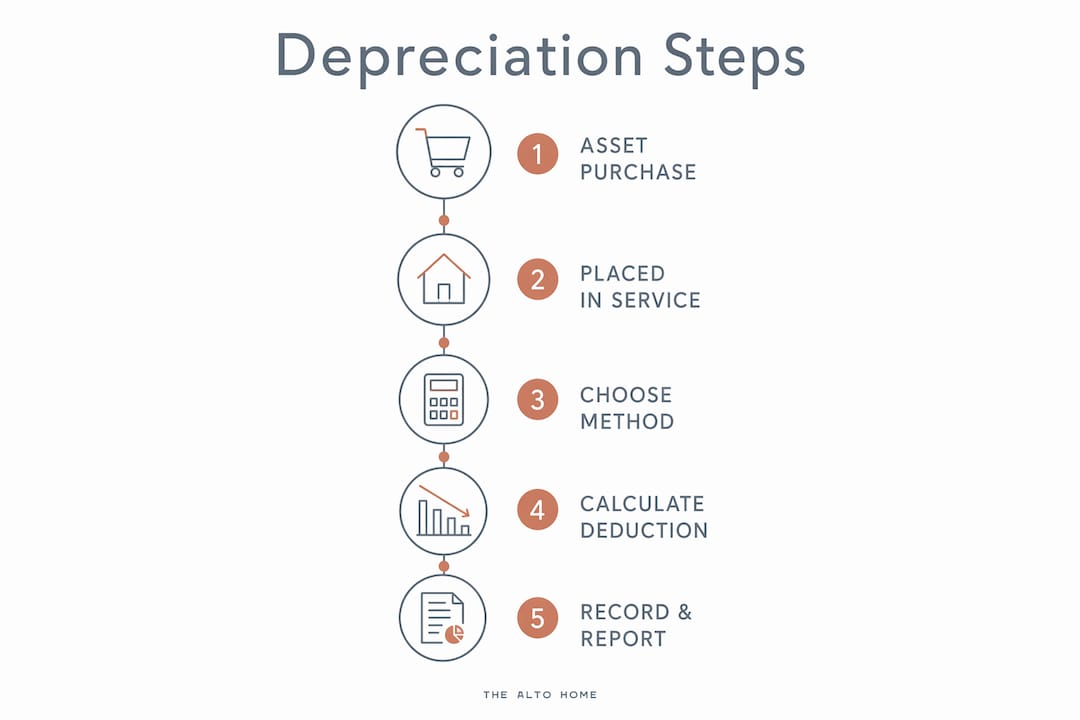
Calculating depreciation correctly requires four inputs: the asset’s cost basis, its placed-in-service date, the applicable convention, and the chosen depreciation method. The following example uses a $10,000 desk purchased in march 2026 under the default MACRS half-year convention with the 200% declining balance method.
Step-by-step calculation
- Confirm the cost basis. The depreciable basis is the purchase price plus any freight, installation, or sales tax. For a $10,000 desk with $500 delivery, the basis is $10,500.
- Identify the recovery period. Office furniture is seven-year property under Asset Class 00.11.
- Apply the half-year convention. Year one gets half the annual rate. The 200% declining balance rate for seven-year property is 28.57% annually, so year one is 14.29%.
- Calculate year-one depreciation. $10,500 × 14.29% = $1,500.45.
- Continue the schedule. Apply the declining balance rate to the remaining book value each year until straight-line produces a larger deduction, then switch.
- Document the placed-in-service date. Furniture must be physically ready and available for use by December 31 to qualify for that year’s deduction.
| Tax Year | Depreciation Rate | Deduction on $10,500 Basis |
|---|---|---|
| Year 1 | 14.29% | $1,500 |
| Year 2 | 24.49% | $2,571 |
| Year 3 | 17.49% | $1,836 |
| Year 4 | 12.49% | $1,311 |
| Year 5 | 8.93% | $937 |
| Year 6 | 8.92% | $937 |
| Year 7 | 8.93% | $937 |
| Year 8 | 4.46% | $468 |
Business use percentage and recapture risk
Depreciation applies only to the business-use portion of an asset. If a desk is used 80% for business and 20% personally, only 80% of the cost basis is depreciable. If business use drops below 50%, the IRS triggers recapture, requiring you to repay prior deductions as ordinary income. Keeping a business-use log is the clearest way to defend your position during an audit. Understanding the total cost of office furniture also helps you set an accurate depreciable basis from day one.
What factors affect office furniture depreciation and lifecycle?
Tax depreciation and physical depreciation are not the same thing. Tax depreciation is a statutory tool designed to encourage capital investment, not to model actual wear and tear. A well-built solid wood desk may retain functional value for 20 years, but the IRS still recovers its cost over seven years.
Office furniture longevity factors
Physical longevity depends on material quality, usage intensity, and maintenance. High-traffic office environments wear through budget seating in two to three years, while quality wood desks in lower-traffic settings can last a decade or more. These office furniture longevity factors matter for replacement planning but do not change the statutory seven-year tax recovery period.
Key factors that affect the office furniture lifecycle in a business context:
- Material quality: Solid wood and metal frames outlast particleboard and plastic by a wide margin.
- Usage intensity: A shared workstation used by rotating staff depreciates physically faster than a private office desk.
- Maintenance practices: Regular cleaning and minor repairs extend functional life significantly.
- Obsolescence: Ergonomic standards evolve. Furniture that no longer meets employee needs becomes economically obsolete before it physically fails.
Tax depreciation versus book depreciation
Financial accounting uses book depreciation, which reflects the asset’s actual useful life as estimated by management. Tax depreciation follows IRS schedules regardless of actual condition. A business may fully depreciate a desk for tax purposes in seven years while carrying it on the balance sheet for 12 years under straight-line book depreciation. These differences create deferred tax liabilities that accountants must track carefully. Exploring multi-purpose office furniture options can also extend functional lifecycle, improving the return on each depreciable asset.
Why most businesses get office furniture depreciation wrong
The most common mistake I see is treating the placed-in-service date as the purchase date. They are not the same. Furniture ordered in november and delivered in december still does not qualify for that year’s deduction if it sits in boxes unassembled on December 31. The IRS is explicit: the asset must be ready and available for its intended use. I have seen businesses lose significant deductions because they assumed delivery equals placed in service.
The second mistake is ignoring state conformity. Accountants who apply the federal Section 179 election to state returns without checking conformity create errors that surface years later during state audits. California’s $25,000 cap versus the federal $1,290,000 limit is not a minor rounding difference. It requires a completely separate depreciation schedule and produces a different state taxable income figure every year until the asset is fully depreciated.
My practical advice: build your depreciation schedule in a spreadsheet or fixed-asset software that tracks both federal and state columns from day one. Do not reconstruct it at year-end. And if you use Section 179 aggressively, model the recapture scenario. If business use of that furniture ever drops below 50%, the IRS will want that deduction back. Documentation is your only defense.
— Kevin O’Gara
Quality office furniture worth depreciating
Investing in furniture that holds up physically and qualifies as a depreciable business asset is a straightforward financial decision. The Alto Home designs standing desks and office chairs built for exactly this kind of long-term business use.

The Gramercy Fluted Wood Standing Desk and the Tribeca Mid-Century Wood Standing Desk are crafted from solid wood with adjustable height mechanisms, making them eligible as seven-year depreciable property under MACRS Asset Class 00.11. The Alto Home also offers the Felix Upholstered Desk Chair, which qualifies under the same classification. Furniture that lasts well beyond the statutory recovery period gives you both the tax benefit and the long-term functional value.
Key takeaways
Office furniture depreciation requires correct IRS classification, the right method election, and airtight documentation to withstand scrutiny.
| Point | Details |
|---|---|
| Seven-year MACRS class | Office furniture falls under Asset Class 00.11 with a seven-year GDS recovery period. |
| Section 179 limit in 2026 | Businesses can expense up to $1,290,000, with phase-out starting at $3,220,000 in purchases. |
| Placed-in-service rule | Furniture must be assembled and ready for use by December 31 to qualify for that year’s deduction. |
| State conformity risk | States like California cap Section 179 at $25,000 and disallow bonus depreciation, requiring separate schedules. |
| Recapture below 50% use | Business use dropping below 50% triggers IRS recapture of prior deductions as ordinary income. |
FAQ
What recovery period applies to office furniture under MACRS?
Office furniture is classified as seven-year property under IRS Asset Class 00.11, giving it a General Depreciation System recovery period of seven years.
Can I deduct the full cost of office furniture in year one?
Yes. Section 179 allows full expensing up to $1,290,000 in 2026, and bonus depreciation covers 100% of remaining basis without a taxable income cap.
What counts as “placed in service” for depreciation purposes?
The IRS requires the asset to be physically ready and available for its intended business use. Furniture delivered but not assembled by December 31 does not qualify for that year’s deduction.
How does business use percentage affect my deduction?
Depreciation applies only to the business-use portion of the asset’s cost. If business use falls below 50%, the IRS triggers recapture of previously claimed deductions.
Do state tax rules follow federal depreciation rules?
Not always. California, for example, limits Section 179 to $25,000 and disallows federal bonus depreciation, requiring businesses to maintain separate federal and state depreciation schedules.
