

Multi-purpose office furniture is defined as any piece that performs two or more distinct functions within a single footprint, making it the foundation of productive, space-conscious workspaces. The industry term for this category is “adaptive furniture,” though most buyers search for it by its practical description. Multipurpose office furniture maximizes real estate by integrating features like benches that become tables, partitions that serve as whiteboards, and ottomans with hidden storage. That triple-duty design philosophy is what separates genuinely useful pieces from furniture that merely looks good. Activity-Based Working (ABW) and hybrid schedules have pushed this category from a niche preference to a core workspace requirement, with ergonomic adaptability now considered a baseline standard rather than a premium upgrade.
1. Multi-purpose office furniture examples: folding and convertible desks
Convertible desks are the most visible category of multi-purpose office furniture examples, and they solve the single biggest problem in small offices: floor space.
Wall-mounted fold-down desks attach flush to the wall and drop open to create a full work surface. When closed, they function as a shelf, a display ledge, or simply a flat wall panel. This design is ideal for guest rooms that double as offices, since the desk disappears completely when not in use.
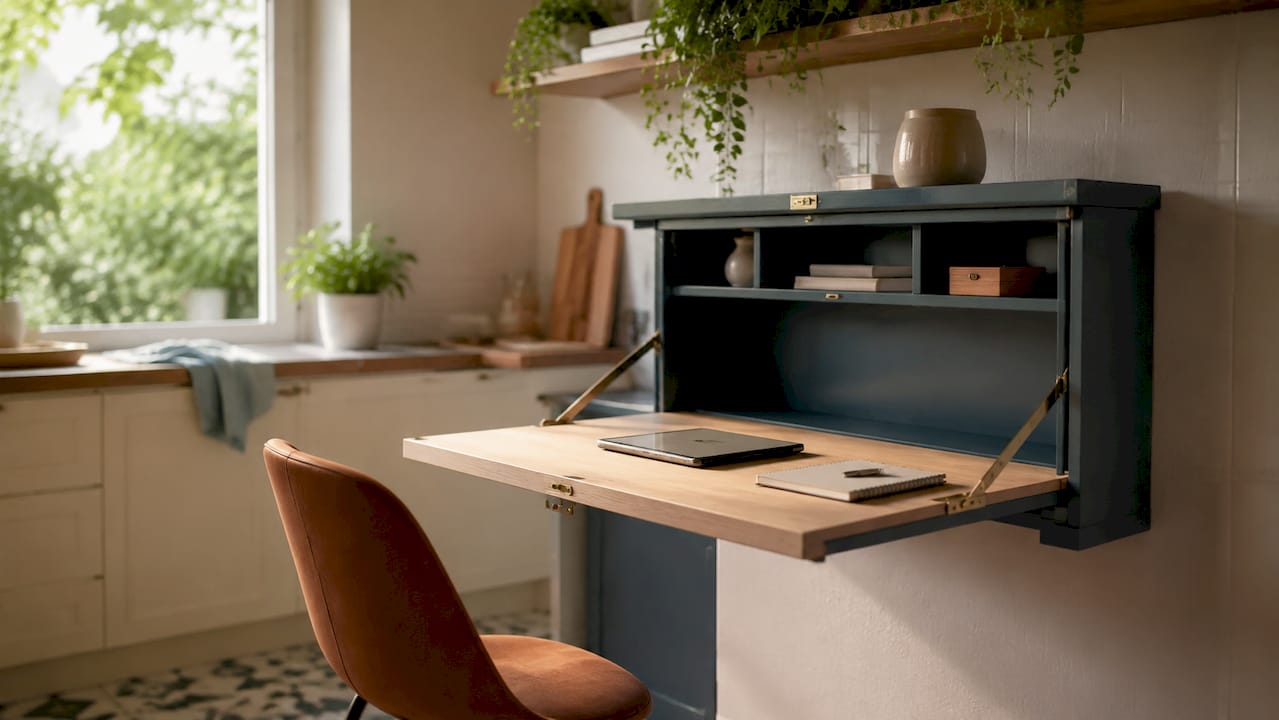
Lift-top desks offer a different kind of conversion. The desktop surface rises on a pneumatic or electric mechanism, revealing a hidden storage compartment underneath. The Bowery Mid-Century Wood Lift Top Desk from The Alto Home uses this mechanism with a vintage aesthetic, giving you hidden storage and a standing surface in one piece.
Height-adjustable standing desks are the most ergonomically significant example in this category. Convertible standing desks enable switching between sitting and standing positions throughout the day, reducing the physical strain of fixed postures. The Alto Home’s Gramercy and Tribeca series use electric motors for smooth height adjustment, making the transition effortless during a workday.
- Wall-mounted fold-down desks: best for rooms under 100 square feet
- Lift-top desks: best for workers who need accessible storage without a separate filing cabinet
- Electric standing desks: best for anyone working four or more hours daily
Pro Tip: When measuring for a fold-down desk, account for the full open depth of the surface, not just the wall bracket. Most models extend 18–24 inches from the wall when open.
Portable desks with fold-flat profiles of 50–110mm thickness reclaim full floor space instantly. That measurement standard, sometimes called the One-Trip Rule, means one person can move and store the desk alone without tools or assistance.
2. Multi-functional seating: chairs, ottomans, and convertible options
Seating is the most underestimated category of flexible workspace furniture. Most buyers focus on desks and treat chairs as an afterthought. That is a costly mistake.
Storage ottomans perform three jobs at once: seating, footrest, and storage container. In a home office, a well-chosen ottoman holds printer paper, cables, or reference books while serving as overflow seating for a second person. Some models include a removable tray top, converting them into a side table for a laptop or coffee.
Convertible chair beds are the right call for offices that double as guest rooms. These pieces fold flat into a twin or full sleeping surface, then return to a standard chair configuration for work hours. The trade-off is that most convertible chair beds sacrifice lumbar support, so they work best as secondary seating rather than a primary work chair.
Ergonomic task chairs are the non-negotiable anchor of any serious workspace. A high-quality ergonomic chair requires a minimum $300 investment to adequately support health and productivity for workers logging four or more hours daily. Spending below that threshold typically means inadequate lumbar support, poor armrest adjustability, and a chair that degrades quickly under daily use.
- Storage ottomans: best for dual-use rooms needing flexible seating and hidden storage
- Convertible chair beds: best for home offices that host overnight guests
- Ergonomic task chairs: best as the primary seat for any worker spending significant time at a desk
Pro Tip: Test an ergonomic chair by sitting for at least 20 minutes before buying. Lumbar support that feels fine after two minutes often becomes uncomfortable after an hour.
The Felix Upholstered Desk Chair with Wicker Caning from The Alto Home merges comfort and visual appeal, making it a strong option for workers who want ergonomic support with aesthetic value in a design-forward home office.
3. Modular and reconfigurable furniture systems
Modular office furniture is defined as furniture built from interchangeable components that can be rearranged, added to, or reduced without replacing the entire system. This is the category that has seen the most growth in hybrid work environments.
Industry experts view modular furniture as a risk management strategy, not a trend. The logic is straightforward: when office attendance fluctuates week to week, fixed furniture becomes a liability. A room configured for 12 people that regularly hosts 4 wastes space and signals poor planning.
Businesses favor freestanding modular benching systems on casters over fixed panel systems for exactly this reason. Casters allow a single worker to reconfigure an entire zone in minutes, without facilities staff or tools. That flexibility directly reduces the cost of adapting to changing team sizes.
| Feature | Fixed panel systems | Modular benching systems |
|---|---|---|
| Reconfiguration time | Days to weeks | Minutes to hours |
| Requires facilities staff | Yes | No |
| Adapts to headcount changes | No | Yes |
| Upfront cost | Higher | Moderate |
| Long-term flexibility | Low | High |
Lounge seating with interchangeable modular components follows the same principle. Sectional pieces that connect and disconnect allow a lounge area to become a meeting zone, a focus pod, or an open collaboration space depending on the day. For guidance on building out a modular office furniture system from scratch, The Alto Home’s 2026 guide covers the key decisions in detail.
4. Storage solutions that combine aesthetics with functionality
Storage furniture earns its place in a workspace by hiding clutter without creating visual noise. The best pieces look like decor and function like filing systems.
Hidden compartment coffee tables and ottomans keep workspaces organized without sacrificing aesthetics or floor space. A lift-top coffee table, for example, stores documents and supplies inside while presenting a clean surface for a laptop or notebook during video calls.
Built-in desk drawers are the most practical storage integration in a work desk. Desks with two or three integrated drawers eliminate the need for a separate filing cabinet, which typically occupies 2–4 square feet of floor space. That reclaimed area matters significantly in rooms under 150 square feet.
Tall, narrow shelving units maximize vertical space rather than horizontal footprint. Wall-mounted shelves and tall narrow units are key tools for compact offices, drawing the eye upward and keeping the floor clear. A unit that is 72 inches tall and 12 inches deep holds a substantial volume of books, binders, and equipment while occupying less than one square foot of floor space.
- Lift-top coffee tables: store supplies, serve as a secondary work surface
- Integrated desk drawers: replace filing cabinets and keep the floor clear
- Tall narrow shelving: maximize vertical space in rooms with limited square footage
- Storage ottomans: hide cables, paper, and accessories while serving as seating
Pro Tip: Label storage compartments inside ottomans and lift-top tables. Hidden storage becomes clutter storage without a simple labeling system.
5. Choosing the right adaptive furniture for your workspace
Selecting adaptive office furniture starts with two questions: how much floor space do you have, and how many functions does the room need to serve?
- Measure first. Record the room’s square footage and note any fixed elements like doors, windows, and outlets. Furniture that blocks a door or covers an outlet creates daily friction.
- Define the room’s secondary function. A home office that doubles as a guest room needs a convertible sleeping surface. One that doubles as a meeting space needs reconfigurable seating and a surface large enough for two or three people.
- Prioritize ergonomics before aesthetics. Ergonomic chairs deliver greater long-term health benefit than any other single furniture investment. Buy the best chair your budget allows before spending on a statement desk.
- Match furniture scale to room scale. A large modular sectional overwhelms a 10x10 room. A wall-mounted fold-down desk disappears in a 20x20 room where a full standing desk would serve better.
- Plan for dual-use rooms deliberately. Rooms that serve two functions need furniture that transitions cleanly between them. For detailed guidance on this, The Alto Home’s resource on designing dual-purpose home offices walks through the layout decisions step by step.
- Choose casters for team spaces. Any furniture in a shared or hybrid office benefits from mobility. Casters on benches, tables, and storage units allow one person to reconfigure the space without help.
- Account for cable management. Multi-functional desks with built-in grommets or cable trays reduce the visual clutter that undermines an otherwise clean setup.
The shift toward Activity-Based Working has replaced fixed panel systems with mobile furniture across corporate offices. Home offices are following the same path, with buyers prioritizing pieces that adapt to their schedule rather than dictating it.
Key takeaways
Multi-purpose office furniture performs best when each piece serves at least two distinct functions without compromising the quality of either.
| Point | Details |
|---|---|
| Ergonomic chair first | Invest a minimum of $300 in an ergonomic chair before spending on any other piece. |
| Convertible desks save space | Fold-down and lift-top desks reclaim floor space and add hidden storage in one footprint. |
| Modular systems reduce risk | Furniture on casters adapts to changing headcount without facilities staff or downtime. |
| Vertical storage multiplies capacity | Tall narrow shelving holds more than wide units while occupying less than one square foot of floor space. |
| Match furniture to room function | Define the room’s secondary use before buying, then select pieces that transition cleanly between both roles. |
Why the “desk-first” mindset costs you more than money
The most persistent mistake I see in home office setups is the desk-first mentality. Buyers spend $800 on a beautiful standing desk and then sit in a $79 task chair for eight hours a day. The desk looks great in photos. The back does not feel great by Thursday.
Ergonomic chairs should take budget priority over desks because of the sheer volume of daily contact. You interact with your chair every minute you are at your desk. You interact with the desk surface for a fraction of that time. The math on where to spend first is not complicated.
Furniture is also becoming a dynamic operating layer, not a fixed installation. Furniture must change weekly to suit team rhythms and collaboration patterns. That insight applies equally to home offices. The worker whose setup looks identical in january and october is probably not adapting their environment to their actual work patterns.
My practical advice: buy one excellent ergonomic chair, one height-adjustable desk, and one modular storage piece. Get those three right and you have a workspace that handles 90% of what a modern work schedule demands. Add pieces only when a specific function is genuinely missing, not because a room looks empty.
— Kevin O’Gara
The Alto Home’s approach to versatile workspace design
The Alto Home builds standing desks that treat design and function as equal requirements, not competing ones. Their wood standing desks, including the Greenwich Rotating Wood Standing Desk and the Gramercy Fluted Wood Standing Desk, combine electric height adjustment with finishes that work in both home and hybrid office settings.
The Bowery lift-top desk adds hidden storage to that formula, making it a strong choice for rooms that need to stay visually clean. The full collection of adjustable height standing desks covers a range of sizes and aesthetics, from mid-century modern to contemporary. If you are building a workspace that needs to adapt as your schedule does, The Alto Home’s pieces are designed with that flexibility built in from the start.
FAQ
What is multi-purpose office furniture?
Multi-purpose office furniture is any piece that performs two or more distinct functions within a single footprint, such as a lift-top desk with hidden storage or an ottoman that serves as seating, a side table, and a storage unit.
What are the best examples of convertible desks?
Wall-mounted fold-down desks, electric height-adjustable standing desks, and lift-top desks are the three strongest examples of convertible desks. Each saves floor space while adding a secondary function like storage or ergonomic positioning.
How does modular office furniture support hybrid work?
Modular furniture on casters allows teams to reconfigure office layouts in minutes without tools or facilities staff, making it the most practical solution for offices with unpredictable daily attendance.
Should I buy a desk or an ergonomic chair first?
Buy the ergonomic chair first. Ergonomic chairs deliver greater long-term health and productivity benefit than any other single furniture purchase, especially for workers spending four or more hours daily at a desk.
How do I maximize storage in a small home office?
Use tall narrow shelving units to maximize vertical space, choose a desk with integrated drawers, and add a storage ottoman for hidden compartment storage. Vertical shelving and fold-away desks are the two most effective tools for compact office spaces.
